
Vectors - The Intuitive Beginning
“A vector represents direction and magnitude — it can describe location, movement, or influence depending on the context.”

Gyaan
Unless you are living under a rock, you should’ve heard the term vector. From school physics books to recent AI articles, one cannot help but come across vector.
So what exactly is a vector? The science says - Vector is a quantity that has both magnitude and direction. In machine learning, it is a list of numbers that represents a data point with multiple features. Okay, I know it’s boring… Let’s dive deep 🤿

Grasstip
A vector is a representation that shows where something is
and which way it is pointing - Scimonk
Often vector is mistaken for a point. Although a vector is written as a set of points (x, y, z, …), it doesn’t represent a point.
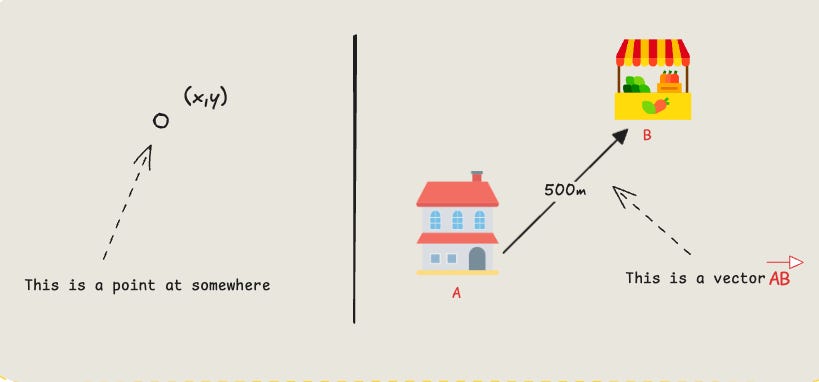
In the image above, the vector →AB shows the location and direction of the shop relative to the home. i.e. The shop (the “something”) is located 500m away from home, towards (“pointing”) the North-East, ~45° relative to home.
⚠️ Note:
The example above represents a position (point) vector — it shows the location and direction of the shop relative to the home. Other types of vectors, like velocity or force, describe change or influence instead of fixed location.
Relevance to AI/ML
Now, what does this have to do with Machine Learning? ⏲️
Apply the same definition here but swap the home and shop for the two data points (like texts or images).
YES. In mathematical terms a vector tells you how far one point is from another point and in which direction.
For example, consider the words “Rain” and “Water.”
You know they are semantically related. If we convert these words into embeddings (sets of numbers), then the vector from Rain —> Water would should how close their meanings are and in which direction one lies relative to the other.
I’ll cover what embeddings are, how text becomes numbers, and why the direction matters in the upcoming articles.
Food for Thought
We’ve learned how vectors represent distance and direction. But they’re not just in math, they’re everywhere.
Next time you open a map or navigate to a location, try spotting the vectors around you. Every road, every turn, every movement - all are vectors in disguise.
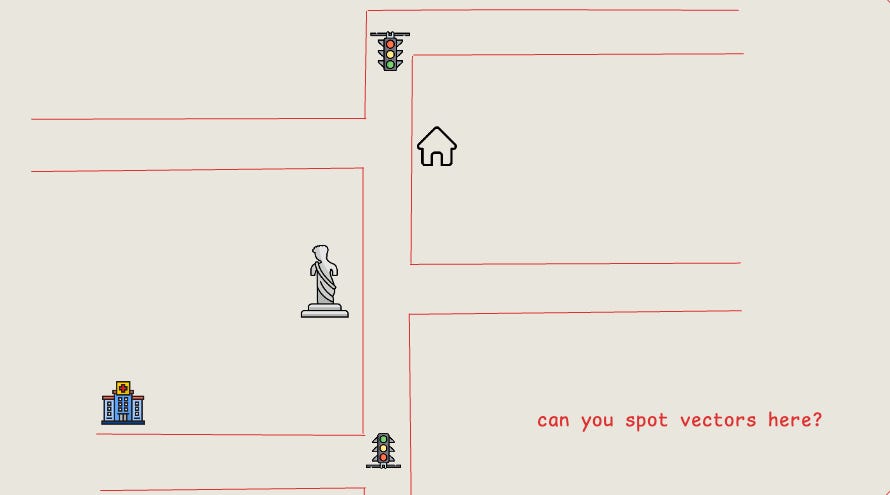
📍 Can you spot vectors here?
Climax
If you have managed to reach here, well done. If you still have questions or doubts, drop them in the comments or ping me.
Better yet, copy this post or a snippet into an LLM and probe it with your questions. You’ll be surprised how much deeper you’ll understand it.
Note: This is the 1st article in the series of Understanding AI/ML jargons. The goal is to make the fundamentals of AI/ML concepts more intuitive.